MASSIMILIANO LUZZI
-
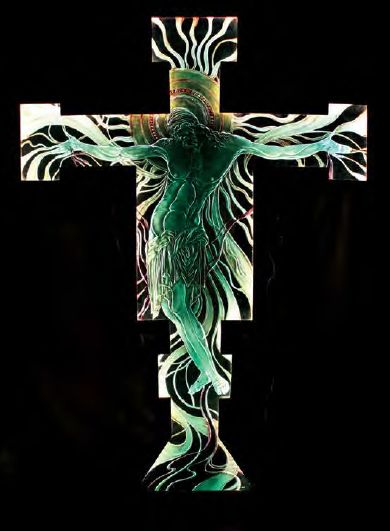
Sacrificio = Amore, glass, wood, LED, 150x5x210 cm Base 75x110x18 cm
Biography
Massimiliano Luzzi, a tireless seeker of harmonious forms that recall the ancestral origin of life, makes glass his favourite messenger.
A difficult material, in which the artist discovers forms and lights of a primordial maternity that leads back to its first womb, water.
The fusion of this unexplored material gives us soft forms that convey a filtered light, like looking at the sky from the seabed.
The world that Luzzi invites us to explore is a world made of sensations, of imperceptible lessons that escape memory and intoxicate the senses, those “Five senses” that resonate in one of the artist’s most characteristic works. Five sensory instruments celebrated one by one on monochrome glass bas-reliefs in which the eyes, the organ of sight, inevitably take centre stage, as the work “I sediciocchi” clearly shows. Sixteen gazes turned to the world, set in a symmetry of four colours, blue, light blue, green and red, which push the viewer’s gaze beyond its own contours, almost as if to remind us of the power of seeing, of seeing beyond.
The work “Gli scrigni” has an ethereal background with indefinite contours, from which harmonious, elongated female figures emerge: caskets, precisely, of a lost, unacknowledged femininity, which Luzzi recovers and presents to us again in his unmistakable line.
The theme of the feminine, very dear to the artist, re-emerges in different works with different intentions. “Il sole della vita”, a work of strong impact, frames our faces in a mirror surrounded by bodies, sinuous bodies of harmonious proportions, which seem to invite us to see ourselves anew through those values of belonging and self-searching expressed in the feminine. The colours chosen are strong, primitive, and alternate, lending the work circularity and a more intense luminosity.
The female body is likened to a womb from which everything is generated, something sacred that must be protected in the entirety of the meanings it guards. In a world in which everything is for sale because everything is merchandise, the need arises to engage with an art of denunciation, and Luzzi accepts this challenge and creates “Merci sacre”. A title which, read as an oxymoron, could in itself already be an act of denunciation against the commodification of the female body and of everything it represents. Female figures, this time black and opaque, are literally scratched, soiled by the outside hand of a world that commodifies them in an attempt to denature them. Nevertheless, a luminosity shines through, reminding us that dirt does not erode meaning but amplifies it, making it an instrument of a denunciation that can save the female sphere.